|
School Years, Ages 6 to 18 (1965-1977)When I went to school at age 6 (my parents didn't send me to kindergarten), school went smoothly the first 2 years. What I remember most was that it was my first rich social experiences with lots of other children. These were very positive, and I had many friends at schools who often liked to engage with me inside and outside of school, but I still liked to spend a lot of time alone. I often wandered off the playground alone to explore the rocks on the dry creek bed and the life in small bodies of water, and sometimes just walked around happily thinking about things, then would go to the swings if one was free. I did not engage in sports. I happily socialized with some other kids sometimes, but I was not very social. At that time, I was not shy, I just was very introverted. I would come home and head back out into nature in the day, look at the picture books at night (discussed in ages 0-6), or play with mechanical things. I remember trying to build an electric motor for a model airplane based on my understanding of electromagnets and some instructions from a hobby kit, but it never spinned. I thought the reason was because the copper wire provided for wrapping around the armatures had no insulation, so why would the current go down the wires instead of in-between them? My father likes to tell the story about when my sister took my beloved transistor radio into the kitchen, and accidentally knocked it into a tub of water. I remember that event vividly. The radio no longer worked. Everybody else quickly gave up on it and were ready to discard it as trash, but I took it away. Since it was already broken, I took it apart because I had always wanted to see what it looked like inside. I took it apart completely and inspected it. Then I put it back together. I turned it on, and to my and everybody's surprise, it worked again. I had always thought that my loner mentality had to do with the environment with my mother. However, my daughter Angela was a lot like me in her youngest years. I could see it in the way she played alone. In her first years on the school playground, she was very popular with other children but she liked to go sit alone in a quiet place and ponder things. The in-laws sometimes complained about this. She would come home and avoid the kids outdoors, instead playing in her imaginary world with her toys. She often had wonderful questions. Likewise, she won't physically fight with other kids. She was big and strong for her age and could flatten any kid her age, like I was at the same age (and I had a deep, thundering voice for a small kid), but she will only talk, and will quickly walk away as soon as a seriously threatening emotion is expressed by another kid, even if it's a conflict between two other kids and not involving her. Angie is as sensitive to violence as I am. So many times I have seen my mother's personality in Angie, and sometimes thought of her as Little Elizabeth. When I was a child, I learned the most valuable things from my parents, my sister and my brother, and not much from other kids. When I was 8, we moved across the Arkansas River to Little Rock. My father had started up a private practice in Little Rock, and had also started teaching at two places part time, a college for minorities called Philander Smith, and the University of Arkansas at Little Rock (UALR). He was doing a lot of work. My father basically bought a small residential piece of land in what was a forested area at the time. My father had a house built for us, and we watched them cut down the trees and clear the land where the house would be built, work with deliveries of construction supplies, and build the house. I loved to watch the builders constructing the house. We were on the side of a little hill which was just forest, with lots of rocks, and a lot of wildlife. There were wild dogs in packs (and afraid of humans), raccoons and other furry mammals, and the streams had a variety of fish. I loved our new home. Most of my life over the next 4 years was spent with the rhythms of natural life, just myself hiking around in the environment. I collected a wide variety of rocks. Some were beautiful, such as pyrite, large quartz crystals, and stones of various colors, but I also liked a lot of the ordinary rocks, including slates, various sedimentary rocks, and granites, as they had their own stories of formations. My favorite locations were small brooks which were dried up, as they had washed dirt away and exposed a lot of rocks. Unfortunately, unlike the school in North Little Rock, the new school in Little Rock was not in my neighborhood and long walking distance away. It was instead a very long distance away and quite a drive. I was the new kid. I clearly came in at the bottom of the established pack social order, and I don't think I moved up for years. There was more of a competition for pecking order there. Some kids near the bottom rungs sensed my aversion to violence and would frequently take advantage of me and bully me a little. Sometimes I would cry and then I was really the laughingstock. I hated school there at first. Practically none of the kids in the school lived near me, but they lived near each other. I was the one out, and hung around only with other a few other new kids as they arrived over the next few years, and most had the same fate as me with the established pecking order -- so the new kids hung out together and separately from the other kids, generally. My brother fared much better, but he was always my opposite in a lot of ways, very socially skilled. Stuart was an artist with amazing drawing capabilities at a very young age, whereas my drawing and even my handwriting were poor when I was young. Even after growing up, my drawing skills are not comparable to Stuarts or other natural artists. Likewise on social skills -- he had what it took to be successful in a new environment, and I didn't. I also noticed that Stuart went with the flow of others much more smoothly than I did, as I was standoffish and observed things awhile before I would consider whether or not to go along. In national scores, my vocabulary and verbal tests were around the 50% level when I was young, whereas my math scores were always in the upper 90s, around the 99th percentile at times, and I was fairly high in other areas, too. I had little interest in school, and was often an irritant to my teachers because I would daydream and get behind on lessons, so the math scores were a big surprise. If they called me by name, I was often clueless about what was going on in class at the time, and I resented the ways they would sometimes scold or try to embarrass me. I just retorted with a quiet, perfectly still don't-give-a-sh*t attitude. I zoned out, and preferred the library and my own pocket books to other kids. What I remember most about school is the feeling of returning from daydreams or from reading pocketbooks or the wrong lesson and not having a clue what the rest of the class had been doing ... I wasn't following, and needed to later figure it out and catch up enough to get by. I didn't like the teachers and they didn't like me, but neither of us cared so we let everything slide. There were charades. I kept up with the lessons from skimming the books shortly before exams, which was wrong (and seeing other kids do this too much later in college was even more wrong, as I had changed in my later teenage years). However, in view of my mediocre grades, people were amazed that I did exceptionally well on national tests in the areas of math and science. In English, I was down in the middle. (This may partly explain my "unique" writing style, as some people put it, as I don't remember teaching about proper writing styles.) I loved being outdoors at home, and that's what I remember most. I almost never did homework. The forests were rich with many kinds of life, and the geology had diverse kinds of rocks. After exploring the region within walking distance, later days I would bicycle way out, hide my bicycle, and hike all day, sometimes jogging to explore places on the horizon, seeing how far I could go but still get back before dark, and mapping out the next region at night. I loved to draw maps. I was in a hilly area, but there were small mountains just a few miles away, they were splendid on the ground when I got there, whereby the tops were magnificent. They usually got rocky at the top so I could get a good view, but sometimes I had to climb a tree on top, which was nice. Thank goodness I never fell out of a tree or injured myself, because there was probably nobody within miles sometimes and it was rugged. I was curious and fearless. I drank from mountain streams like cave men. I observed wildlife. Day after day, I felt very happy hiking for hours in the forests and nature, and in the summers enjoyed the streams where I would cool off. I wondered a lot about the universe and life, and was awed by the sheer size and complexity of life in the forest, the world and the universe. Every part of the mountains and forest was the result of a long time of geological transformation and ecosystem evolution, random in its origins and ordered by natural selection. This is something I didn't share with many other kids at that time, as I felt very different. For other kids, hiking into new places was an adventure and exciting for awhile, but they sometimes killed or damaged things and did other irritating things, or else talked too much about people and other things back going on back in the neighborhood which I preferred to leave behind. There were just a few friends who I could share my hikes with and feel happiest. I preferred to be alone with the other life in nature, and keep others out unless they shared my respect for, and awe of, nature, including the little things, plus were not too talkative about social or action items back in the neighborhood. I liked calm minds which also got absorbed in nature. There is a "story" in the hi"story" of every little animal delivered, every tree stump, rock, and stack of dirt and decaying matter. Everything has its own story. Most other kids just thought of some personified "God" which they had little idea about, except "he" (not she) was some holy "father", "who" had "created" all this that we were walking on, and then some guy named "Jesus Christ" who would be their personal savior if they followed some rules. I thought what typical idiots, still believe in Santa Claus, but they couldn't let go of their security beliefs and wishful thinking. For some people, nature was "God's country", but who, or what, was "God"? A holy spirit for Goodness and evolutionary progress is something I could identify with, but insensitivity to other life was not what I think a good "God" has in mind. Some even liked to take a BB gun and practice shooting squirrels and birds, killing just for sport. That was very painful to see. Indeed, most of the other kids thought the Earth was created 6,000 years ago and everyone came from Adam and Eve. Disagreement was fine, but I was taken aback by the occasional emotional animosity of this sort of disagreement, and the ganging up against me of particular subcliques. I learned to be quiet and not raise issues with some kinds of people, and not state my own beliefs unless I knew it was safe to do so. On the other side were the reasoned who just got quiet and thought about it. Some were uncomfortable and still feared "God", some just suspended making a choice, and a few said yeah, makes sense. There weren't many kids in Arkansas to talk straight with. It was part of The Bible Belt, local groupthink, and identity politics, too. It created a yearning for me to someday head to a place of higher learning, though I didn't want to go to any institution according to my young outlook on institutions. I didn't like school. I just wanted to be in a better society. I had an ideal society which I imagined, maybe somewhere in California or New England or Europe or the UK, far outside of Arkansas and The Bible Belt. I wasn't so sure about Asia as I heard there were different religions there, and I didn't know much about them. I was impressed with the no-nonsense people and diversity of New York City, where my grandmother lived and I had visited very briefly. They seemed reasonable and functional, and very tolerant and openminded. New York City was fascinating. At the time, I thought maybe I would like to live there awhile when I grew up. Church was important to many kids, both socially and to give them security beliefs to relieve them of fear of death. My parents had brought us to church (Calvary Baptist) for a short time as kids but had decided it wasn't for our family. For me, religion was fascinating and full of a lot of good morals and concepts, and a lot of good people. On the other hand, it was also full of hypocrit kids who attended but didn't practice the moral precepts in their private life, and maintained a simplistic dogmatic view of life and the universe. Go out and sin all week, then ask for forgiveness on Sunday, such as just confess and ask Jesus Christ to simply wash away your sins, then do it again the next week. (Ten years later, at the university, I was shocked to find that some of the top academic achievers in my classes still thought the Earth was 6,000 years old, and people of other religions would go to Hell because Jesus Christ wasn't their savior. Church had many totally idiotic and spiritually clueless attendees, ironically. I felt sorry for people who were raised in that dogma from the very beginning of their lives, perhaps with much stronger social pressures than I had.) (In national exams, Arkansas was ranked 49th in some ways, while Mississippi was 50th. "Thank God for Mississippi!" I joked.) If there was no promise of the one big benefit -- life after death and something called "heaven" -- then they would not be following their religion, and many would not be toeing the religious teachings of morality. It seemed that religion was a way of shepherding the masses and controlling behaviors from getting too immoral. It was a code of sheep shepherds thousands of years ago who were mostly illiterate and ignorant. It kept people morally in line. If-thens. If you do good, you go to heaven. If you do bad, you go to hell. Same whether or not you accept your savior's dogma. I would sometimes as "What is "heaven" and "What is 'God'"? Luckily, there were people from modern cities out-of-state who were moving in, in droves, as a major golf course and an interstate bypass had been built near my scenic neighborhood, and beautiful custom modern homes and amenities were going up all around us. It became just half an hour from downtown Little Rock by expressway. The beautiful natural area was a magnet. Most of the people moving here were coming from bigger, more modern cities of other states, mainly the northeastern U.S. and midwestern cities like Chicago, and these kids had generally more enlightened ways of thinking, thank Goodness. That the neighborhood was growing up all around us meant three things: destruction of the environment, lots of building materials and scrap heaps to take things from and build with, and refreshing new friends. I became very aware of the destruction of ecosystems. Downstream, far from the construction, the fish, mussels, and other water related wildlife died out for the most part. Mammals also disappeared. Some of my favorite places were cleared for construction. However, water life in the woods far downstream was decimated by invisible chemical pollutants, and a lot of mammals retreated far back into the forest. All of this had a profound effect on me and my conversion to environmentalism for awhile. On the other hand, I enjoyed watching the houses be built, by going inside and seeing everything they were adding and doing, in stages. It was modern technology and engineering. I scavenged construction materials and built tree houses, from the scrap heaps at construction sites, dragging the materials considerable distances. Some tree houses were multi-level. Some were just a little bit off the ground, and others were way up high in a tree where they were hidden, with a lot of time and effort attaching and pulling wood up on a rope every day and building. I had all the free time in the world as a kid, and looked forward to getting home from school every day in order to resume the next stage of the project. I spent a lot of time in school dreaming up designs, as well as at night. Some projects took quite some time to build, but I had multiple tree houses spread around the remaining forest in the neighborhood, and I loved hanging out in them. I usually hung out in them alone, but sometimes I would bring friends. Some started being used by others. Our back yard was big, as my parents had kept many of the native trees. One of the buildings I made was in our back yard. I was working on floor 3 when one day I came home from school and was SHOCKED to see it missing. It turns out that my mother had decided, without telling me or discussing it at all with me, that she would hire a man to come disassemble it and remove it while I was at school. She obviously didn't tell me because she knew how strongly I would object. I asked why and she said because there could be spiders and bugs inside which might bite me. My mother was known to have a germ phobia, according to my father, and it was occasionally an issue at home, the extreme cleanliness and requested protocols at times. I became very angry at her about the secret destruction of my special project and didn't talk with her for a long time. She commented that the guy who took it down said it was well built and strong. I always designed things carefully and put in safety factors. I was also known for having "a green thumb", in that I would sometimes save beautiful plants from lots which were about to be bulldozed, but digging them up and carrying them back to our yard, planting, and cultivating them there. I had a variety of environments to choose from. Our yard was on a slope. Next to where they had cut a level place for the driveway, there was a steep rocky slope without much plant life, so I put cactus there and it thrived, growing tall, spreading, and putting out a wide swath of beautiful yellow flowers and red seed pods. In other parts of the yard, in shaded and sunny places, I put other kinds of plants. I did not want to disturb the natural forests, but I did want to save plants in places which were about to be bulldozed for construction. I nurtured transplants, loved to watch plants grow and develop, and also planted some seeds and watch the entire life cycle. I also bought some tropical plants from the market in the spring, knowing they would die at the onset of the next winter, so there was some variety over the years. I lived in my own world most of my childhood, though I had a few friends towards the end of my "childhood" before adolescence, mainly kids in my neighborhood who had moved in from other parts of the country. Maybe worth noting is that during elementary school, I was around the top male in the class, and it seemed that other guys didn't take much interest in school, but some girls in the class were above me and diligent high achievers. A few of those were outright competitive and hostile to me, whereas they ignored the other boys. It was like an instinctive competition for status in the class, and I was somewhat close to them in some subjects, though I was far away in others. I tried to ignore them but they wouldn't leave me alone, and they rejected any attempts to make peace. If I tried to speak with them about something interesting, they would sometimes twist it into something stupid which I didn't say, and then go tell others lies about what I said and how stupid I am. It was my first experiences at being falsely characterized by an aggressive attempt to "paint me" in others' perceptions as something I was not. If I tried to argue with them, they would distort what I was saying into something ridiculous and extreme, and criticize the "straw man" they were painting. It had an effect on me in that I became even less willing to argue with people who were too competitive and status oriented. However, I learned some things which still apply to many adults in today's political world. My social life didn't really take off until I hit adolescence and the hormones started flowing. My brother had started getting facial and body hair at an exceptionally young age, and mine wasn't far behind. Some kids called me "Link" and "Dar-baby" in reference to Darwin's "missing link" and my ascribing to evolution. It kind've fit me, so I didn't resist and laughed along with it, even though it sometimes seemed to be used as a slight put-down by twerps making fun of me, and some people suggested that I shouldn't tolerate it. Fortunately, it was just a few people who did so and they were friends, at least somewhat. My newly blooming social life seemed to follow my newfound interest in the opposite gender, due to hormones from the development of my endocrine system at that age. I was not thinking of that in scientific terms at all. I just got absorbed into social things. I was considered a good looking guy and was told of many ladies who were interested in me. I actually didn't chase ladies, generally, as I was shy, but I did engage with many ladies who liked me. At about the same time, I entered a big new school at age 12 and ventured into new social groups, entirely different from the ostracizing establishment from age 8 to 11, and that was a new beginning in my social life as a kid, a reinvention of myself. Part of this was due to "racial desegregation" whereby the government started mixing African-Americans and Caucasians in the schools by bussing us around to bigger schools. Also, as the local neighborhood grew up, I had more "new kids" from other parts of the US to make friends with. We were bussed together since we were from the same neighborhood. The old "establishment" neighborhoods were just over a border nearby. The city bussed the new kids in the new neighborhoods to avoid resistance from the establishment. The bus drove thru the establishment areas on the way in, past several other schools. This was the early 1970s, and my parents had always raised us to treat minorities of all races and types equally. My father taught at an all-black community college on the weekend, and would take me to mixed race social events and clubs. I was way ahead of other kids in my neighborhood when racial desegregation came to Arkansas' sociopolitical life. When I entered this school desegregation program, I was shocked at all the racism, on both sides, because I was so accustomed to no racial friction between my father and his students and extracurricular activities. As a hispanic, he identified with them, something I came to realize. I became one of the white leaders of the middle merge group, which was basically the blacks from good families and the whites with similar upbringing to mine, not the bigots on both sides. America had just passed thru the 1960s, the beginning of the Civil Rights era, but attitudes didn't change quickly in society, and this was the first time that many white kids had seen black people like that in person. Now, it seems barbaric, but these changes in civilization as regards race relations happened within my (our) generation. It's interesting to try to imagine previous generations. In another way, I had felt socially "excluded" during ages 8 thru 11, and I empathized with others who were similarly excluded for various reasons. As I established higher social rank, I still wanted to remain "inclusive", and felt that every person had their special talents, but many people in my group still wanted to be "exclusive", and I usually didn't try to persuade them otherwise. As long as someone wasn't hostile to others, then they were OK by me, and I would privately reach out to a lot of "excluded" kids of every race, height, and economic status. I hung out with various groups in diverse places. However, during that period, I also did some regrettable little juvenile things, such as pranks against people I didn't get along with, and minor vandalism. It's kid stuff, but I still regret those now. I think about what was going on inside my head at the time, so that I can try to understand other kids and people who do those things, as part of the human experience. When I went along with a group or a friend about doing a bad thing to some other person with whom I had no reason to do anything bad to, I later felt guilty and empathised with what they must feel and think afterwards. Typically, it was some insult, put down, or attempt to make them feel bad. It's interesting now to think about going along with friends to do bad things. I wish I could right some wrongs, but it isn't feasible, so best to learn from it and move on. Fortunately, it was all very minor. However, I learned about hanging out with the wrong kind of group and people, and how you can go along with them too far. I hung out with some kids who were poor academically but trendy, had their own groups, were exciting socially, and were relatively independent and a bit rebellious. I grew my hair long, which was a new thing for men in that era. The named categories for social groups, not my creation but just how other kids categorized classmates, included the "jocks" (athletes) and "socies" (cheerleaders and fans) at one extreme, the "freaks" at the opposite extreme who were the kids who had long hair, dressed like trendy rock music people, and included dropouts from societal traditions and a bit of a rebellious streak, and the third main category which was the "squares" who followed their parents rules closely, many but not all of whom tried hard to do good in school, had old style haircuts and clothes styles, and followed all the rules. For awhile, I became embedded in the "freaks" and proud of that identity at the time. The freaks were a category which included a lot of very laid back and unambitious kids, who were easygoing, relatively inclusive of a wider variety of people, and didn't like people who hassled anybody else or played games of relative status. Actually, some came from poor socioeconomic backgrounds on the bottom rungs of society, and all came from either liberal or negligent parents. Some were very wild. It was quite a mix and variety of characters, but it was inclusive as long as you weren't a jock, socie, or square. There were multiple subgroups of freaks. There were also lots of uncategorized kids, such as groups of a few friends. I drifted in and out of belonging to various inclusive groups of freaks by conforming for awhile to their styles, but after checking them out and getting bored after awhile, didn't stick to any one group for very long, and eventually went back to being independent. However, I didn't mix with people in the other main categories. I had such a wide variety and large number of friends, it was an astonishing contrast to my life before. It went from one extreme to the opposite, from loner to super social. However, I learned a lot about the variety of people in life, and learned to read people much better. My new social life combined with poor school discipline resulted in my nearly failing grade 7. I daydreamed often in classes. My grades degraded from high at the start of the year to some D's and F's by the end of the year, especially English, and they said I'd need to either need to repeat grade 7 or else go to summer school (though I think they were exaggerating just to scare me into getting serious about my negligence). English was the one class you were not allowed to fail, and I had failed it. I really disliked my English teacher, and I sensed she disliked me, too. As one longtime neighborhood friend said, he was shocked that the "walking encyclopedia", as he called me, was actually failing a grade. (A lot of my education was extracurricular in the library before that time.) Many people were in disbelief about how I had transformed. My mother didn't want me to go to summer school because it was full of "bad" kids, whereby she didn't want me to hang out in that peer group, so she persuaded the school authorities to allow her to home school me over the summer and to enter 8th grade. English was really the only subject which I needed to "pass", and that's most of what she focused on. That summer, as my mother taught me English at home, I went from hating English to enjoying the rules of grammar, the origins of words, the history of exceptions and slang, and so on. My mother is a wonderful teacher. I also straightened out my worse juvenile attitudes. My mother was more effective than my father in persuading me about things. She was also a better teacher than my school teachers. She had gone to talk with some of my teachers when the passage crisis happened, and it seemed she had some mixed reviews of the different teachers, some she liked and some she didn't. My mother had a lot of self-confidence in her ways, and better ways and outlooks. She always had confidence in me and encouraged us in independent and divergent thinking. She was a critical thinker, and she wasn't naive about the real world when it came to teaching, though in other ways she was isolationist and quite naive. My mother didn't socialize much in the community, wasn't status conscious, and held no pretenses. She is just plain honest and straightforward. English still remained my worst subject by far for the rest of my formal education as regards grades, but that was simply had no interest in reading poetry and the classics, and didn't give a hoot for whom the bell tolled. Call me uncultured, but I just couldn't bear to read the old stuff and I was pretty good at sitting in the back of the class hiding other reading material inside my textbook, or just daydreaming or doing other stuff. Words and their roots were about the only things which fascinated me, the only nuggets I could extract from all that, but my vocabulary was still not nearly as good as some of the good students. Grammar was easy, except for some of the grammatical exceptions of English. It was like excellent grammar partly raised my English grades, while work on the classics and poetry brought those grades down, so putting it all together put me around the middle of the class overall. It's worth mentioning because some people compliment me on my writing now, unlike my teachers back then. There are vastly better writers out there, and I know I'm a decent writer only in my own realms of interest. It comes down partly to motivation. Also, I didn't learn much about standard ways of writing, which may explain why some people call my style "unique" at times. Definitely not a copycat, nor steeped in conventional styles of writing. However, I am practical, and try to write in simple ways to be well understood by ordinary people. I don't try to compete by using big unnecessary words and elite poetic sentences. When I proofread what I write, I often try to simplify it, such as taking out words which some people might not understand, including people who have an education much lower than my own, and non-native English readers since I've lived overseas. At ages 13 and 14, I was bussed all the way across town to a school in a black neighborhood, whereby the school was 37% white and 63% black. Horace Mann Junior High School, named after an American anti-slavery educator and politician of the mid-1800s, who also advocated secular education. The school and its books were in terrible condition, quite a shock at first at the inequality, but socially it was heaven for me because almost none of the kids from my childhood past went, so I could reinvent myself. Instead of the busses being full, they were nearly empty, except for the kids from parents willing to live the desegregation experience of that era. The wealthier local households had put their kids into private schools or pulled strings to get them into the closer public schools so they wouldn't be bussed. For me, it was an adventure, and I thoroughly enjoyed and explored the new environment. Nearby neighborhoods were also sprouting up outside mine, with lots of kids new to Little Rock, coming in from all over the country (and a few from other countries), and my social life was all apples. More and more new kids were getting on the bus. The initial mostly empty buses of the first years of racial desegregation filled up, and more buses were needed. My scope of friends expanded. I was a very poorly self-disciplined kid and still wasn't doing as well in school as before, but for the first time I can remember, I started to like my teachers and got along with them. I also enjoyed school for the first time. Many of the teachers were very humble and earthy in the desegregation schools, less pushy, more accommodating of freaks, and seemed to me to be a bit more advanced in intellect. I think the teachers were chosen very carefully for the desegregation schools. They surely were more enlightened than my earlier teachers. I had also transformed into a socially self-confident and proud person, as well as a bit rebellious. I was considered "cool", and became quite popular, which was new to me. I was still quiet, but I made friends easily and seemed to get along with most everyone at the new school. I had never been judgemental of other people, but I really enjoyed other people for the first time, and I had diverse kinds of friends. The emotional and social transformation is something that's hard to convey in writing, but it was a major metamorphosis. Decades later, I watch groups of teenagers in shopping malls, trends and the media, and it reminds me of my years almost long forgotten, the feelings and social dynamics.
That photo is from hiking up and down a mountain, which some companion took, a rare photo of me in nature by another kid during the time of film cameras. I usually preferred to hike thru nature alone, but hiking with more relaxed country girls was OK, much less so with city girls. However, I usually hiked alone or with another laid back guy. My school grades recovered and started rising. I remember Reverand Howard, my black science teacher of the 8th grade who taught evolution during the week and was the preacher at a church on nights and weekends. Everyone sensitive who used their brain and their heart loved him. I cried when he died of a sudden heart attack on the school parking lot (apparently an embolism, as he suddenly passed out quickly), as did so many others of most different kinds, especially my favorite teachers. He was extremely overweight. I didn't see it, but it was a major ordeal and the teachers and some students who loved him were in shock. I wasn't ambitious or competitive like some other kids, and I usually still sat towards the back of the classroom, but I was engaged with classes. My grades surprised me. I couldn't understand why I was doing better than most of the kids at the front, who I felt sorry for because they took books home and tried too seriously. They were too rote and conformist, I figured, too "square", and had never learned to think much on their own. My second desegregated school was also way across town to Little Rock Central High where I was still in a majority black, minority white school (54-46). It was another social reinvention because there were some adjustments to school zoning, whereby nearly all my previous friends went to different schools. I was in an extreme outer suburban neighborhood at the time, which got carved into going to Central despite being the furthest from Central. Many rich families were very class conscious, fearful of some things about integrated schools, and/or somewhat racist, and put their kids into expensive private schools rather than participate in national racial desegregation. I was so lucky to have the parents I have, who let me get on the bus and participate in racial desegregation. My parents also didn't push me too much academically nor create great expectations, unlike parents in some rich families. However, my outer suburban neighborhood was growing quickly, as they continued to bulldoze the hills and small mountains for scenic houses, mainly for people coming in from other parts of the country. I always wondered why they were coming to Little Rock, but it was a place with a nice environment for those who knew, and a growing economy. I remember one girl who just cried and cried on the way back from school on her first day. She had gotten on the bus from a new home area on a scenic hilltop which I'd previously hiked on before it was bulldozed for building houses. Nobody knew anything about this new girl, so I went and talked to her, just pure compassion. Surprisingly, she could hardly speak English, and had a heavy accent. She had just arrived from France. I thought of how my father must have felt going to school, though he's a lot tougher than she was. She seemed so sensitive, but over the year, I saw her adapt so well an change so much. I was much less social in high school than the few years before, and happy to reinvent myself as I wanted to shed some things from my old persona. I had a small number of close friends, and a moderate number of acquaintances who I interacted with repeatedly. All were moderate kids, no extremes. I also did much better academically, and started making nearly all A's except in English. Once, there was an annual statewide exam competition between high school achievers, held about 50 miles out of town at Arkansas State University, and teachers encouraged me to get on the bus and go. It was a LOT of kids from all over the state, the top kids. I figured there were so many much more studious and disciplined kids who did their homework over the years that I would just blend in somewhere around the middle. I was a bit intimidated and didn't feel like I fit in so well. After the examinations and scoring, we all got into an auditorium and they started to announce the names of the winner, second place, and a few honorable mentions in each field. I was bored and not paying much attention, but much to my surprise, I heard my name called. I got a couple of honorable mentions in math and science. No top prize but I had to be in around the top 1% or so to get mentioned out of the crowd. I think it was based largely on prior reading of pocketbooks by Isaac Asimov, not the classroom books, and my love of science. People around me were just turning and looking at me and saying "congratulations!" and I was just stunned. My name called out in that auditorium of all those top students statewide... I just couldn't believe it. Me? This included some good students from the rich kids school I'd hated in yesteryears (because they were too competitive and snooty, and tried to put down others) and who I'd seen there. Likewise, they probably just couldn't believe it was me, that name over the loudspeaker in the auditorium at the end, especially after my rebellious years. Watching the other kids from other towns, who were so friendly and well behaved (I've always liked small town, small tribe people), I wished it had been them to go back to their town proudly, instead of me. What are the teachers and library like in Bauxite, Arkansas? Any Asimov books in the book store? What's it like living there? This was a new element to my identity that wasn't easy for me to accept. I was more comfortable being anonymous. I didn't want people to start to have expectations of me, or start watching me. I didn't want to conform nor did I want to disappoint anyone. I got very shy about my achievements. Fortunately, other classmates got more attention in other ways in academic recognition. I tended to do well in math and science, but not so much other areas. Some kids did the full court press. I was more into extracurricular interests, expecting no recognition or credit. I read a lot on my own, especially pocket books on science while hiking. Two things which got my imagination were the idea of space settlement and artificial intelligence. I had seen artificial gravity in the rotating orbital space station of the 1968 landmark movie "2001: A Space Odyssey" by prominent science fiction author Arthur C. Clarke and movie producer Stanley Kubrick, which also featured the artificial intelligence computer HAL on the mission which went rogue. Later, I read the science fiction book "Rendezvous with Rama" by Clarke, about a large alien spacecraft which is a rotating cylinder producing artificial gravity on the inside, and is explored by humans. It made me wonder about creating cities in orbital space along the same lines in the far future. My high school had a class called Science Fiction which of course I chose as an elective. (When my daughter attended the same school around 40 years later, they said no way would that be permitted again in the current political climate and control over curriculum!) It was a wonderful and popular class. At one point, partly due to students who were into drama on the side, we started to produce a skit which was a Star Trek spoof, whereby they chose me to be Mr. Spock. The most interesting person in the class was Jeff Ledbetter, the son of a prominent liberal state politician known as Cal Ledbetter. Unfortunately, nearly 10 years later, Jeff died while working in politics in Washington, D.C., when he was 28, collapsing during physical activity in a deep snow, due to a previously unknown heart condition, an extremely sad event. Bill Clinton spoke at his funeral. Jeff was working in the Senate at the time while I was working as a physicist in the government space program. Jeff had moved from Arkansas to the Washington, D.C., region in 1985, the same year as I had (early 1985). It was quite a shock, and extremely sad. It reinforced my resolve to get things done while I was still alive. But back in high school, even after all the discussions about the future in Science Fiction class, I was still not clear at all about my future. I didn't know about politics and society like some of the other kids such as the Ledbetters (Jeff had a brother Grainger but he was much lower profile than Jeff), who asserted themselves in school politics and journalism and had a politician father. I also felt that there were certain expectations of them, which in a way I felt sorry for them about, the pressures and scrutiny, moreso for Grainger. I couldn't engage in debates because I didn't know the issues well enough, and it was better to stay quiet than make a fool of myself by opening my mouth. Some people pushed me to get involved in politics, but I shied away from politics altogether. In retrospect, I wish I'd followed others' encouragements to get more involved in the issues and with the political people of my age the time, at least socially, though mainly for better personal and intellectual development. Nevertheless, I still try not to get sucked into politics, and pick my battles carefully. I was a technology enthusiast who thought that the solutions to the world's problems were in technology, and arrogantly thought that some people who were weak in technology while strong in political skills did not have the best solutions, just the only solutions they could think of. I thought that technological progress would transcend many sociopolitical arguments. That is a view which I no longer harbor, as indeed most of our problems are human problems, not technology problems. Nonetheless, looking back 40 years later, in hindsight we can see that indeed technologies such as internet have clearly transcended traditional diplomacy and big government in many ways, by going directly to the grassroots. Nevertheless, it's the same old human issues, for which we need sociopolitical solutions, not just technological solutions. When people started to ask me what my future plans were, like the career counselors at school, I was completely blank, and embarrassed. I felt stupid. I didn't even know about universities around the state, much less the country. I doubt if I was ever on any short list of the 10 most likely to succeed from my class. However, when the year book was being developed, they asked me to pose helping another student with their school work for a big picture in the school year book. Actually, I would have made an excellent professor, no question about it, because my gift at the time was explaining things to others. I believe that the biggest "secret" to doing well in school is enjoying learning for its intrinsic reasons -- the love of knowledge and learning, not its extrinsic reasons -- to satisfy parents or impress other people. The latter is a recipe for stress, burn out, and occasional failure. I always felt sorry for the kids at the front of the class taking notes too abundantly ... Also, if you don't enjoy learning, then you forget more of it all after passing the exams. So what's the purpose of making good grades? Research has shown that there actually isn't a very strong correlation between grades and "success" 10 years later, and that other factors weigh heavier than many people realize. It was during my teenage years that I started to become known as somebody who got along exceptionally well with a wide variety of people. In retrospect, my social development was just as important as my academic development, though I still think my social development was one of my weak points because I stayed shy and unassertive. I had never been very competitive in any way up thru that point (though I did experiment with adding quite an edge later in my life, on and off). I did enjoy sports and played baseball and one season of football in a light non-school league. I didn't like contact sports or aggression, so I played them sparingly. But in my senior year, I actually got into a school sport, at the encouragement of a close friend of mine, Bruce Jeffrey, a track star. It was called "Cross Country", an autumn season sport, whereby teams race over a grass course, such as a golf course, over a few miles. My school had won the state championship the year before, so I didn't expect to even make the team, but just to run with them socially. However, I improved quickly, made the team, and came in fifth in the state, second on the team, in the championship run. (Our school won the state championship again.) Bruce was the only person before me, by 2 seconds, and he was lucky I didn't know the course from the previous year because I thought we were still far from the finish line. I finished with too much left in me. Everybody else was very surprised because I'd barely even made the team of 7, but I was the most surprised person of all. A young guy on the team, Martin Fulk, had gotten me interested in recreational/social running. Little Rock had recreational running clubs, "road races" and "fun runs" which attracted hundreds of people per event, and were normally run over scenic areas. There was also the Little Rock Hash House Harriers which ran every Sunday over rougher terrain, often out of town on nature trails, which was my favorite. In track, the spring season running sport, the longest race was the 2 mile event, and that what I specialized in, together with Bruce, and we consistently came in 1-2 on our team, knocking out the previous year's state champion, Robert Addington. On the championship night, I had a stupid idea that eating several spoonfuls of honey 30 minutes before the run would give me an energy boost and advantage, and didn't listen to a friend, Robert Addington, who warned me against doing such a thing. I thought I'd win this one, the only one that counted. Instead, in the championship run, I got a terrible cramp and dropped out. My science was bad. It was also a hot night, and a competitor from another school, Phil Sudman, walked up to the starting line with a soaked head, soaked shirt and shorts. His science was smart -- artificial sweat to keep him cool on this unusually hot night. Phil won the race. I was disgraced, though it wasn't anything intense. I was happy to have made the team and lettered, though I wasn't so happy to wear my jacket any more. (My college age girlfriend at the time had a dog who chewed it up a bit, so it became a moot issue.) I had also somewhat disengaged by late in my senior year. I had a new girlfriend in a local university who was a master classical pianist, whose music I was impressed with, and we kind've did our own thing outside of social circles because we didn't fit in together to either group. Her friends were artists, mine jocks and kids. That was the last half of my high school year, so it wasn't long. Back in school, practically all of the other people of high academic achievement had been applying to Ivy League schools, special private universities, and out of state universities based on their chosen career. I had done nothing. People kept asking me where I was applying, and I had no answer. About to enter the university, I had no idea what I wanted to do in my life. I wasn't going to waste my father's hard earned money on no clear ambition, so I just decided that I would enroll in my state university, which was cheap for residents of the state. It had a good library, and the laws of physics are the same in Arkansas as they are at MIT. (My grandmother lived in Boston and once suggested MIT.) I decided that I would leave home and go to the main campus 200 miles away in Fayetteville, Ark. Very quickly, high school was over. As usual, I didn't attend any graduation ceremony, as I get very bored with ritual customs like that. I enrolled at the University of Arkansas, the main campus 200 miles away in the northwest corner of the state. It was in the foothills of the Ozark Mountains. It looked like heaven to me. Untouched nature and mountains were clearly within sight and a short drive away. Indeed, I read lots of books while on hikes there and away from distractions over the years. (Ah, the time before mobile phones ... I do miss some things about that time -- getting away!) My university years opened a new chapter in my life, when I first started to get serious about my future.
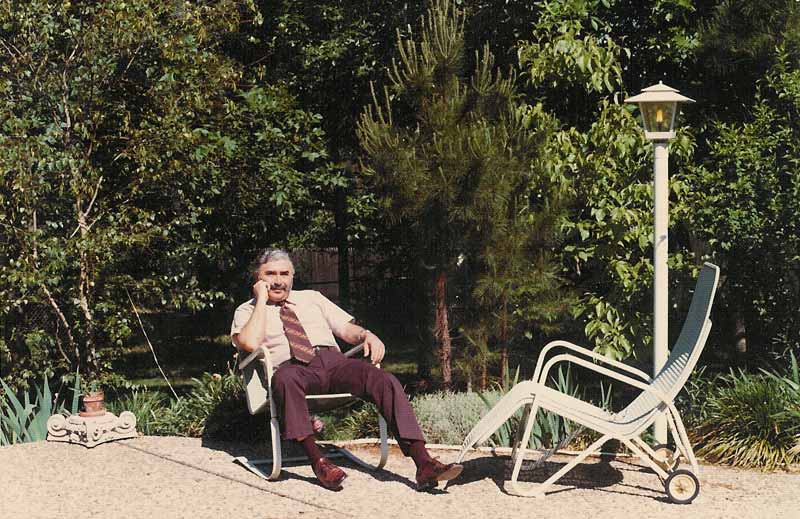
Here's a photo of my father in our back yard in Little Rock. He provided a wonderful environment and financial support in so many ways while I lived at home before I left for the university.
This has become one of my favorite songs of the 1970s decade, Take a Pebble, speaking of memories and people:
That was one of my favorite bands, "Emerson, Lake, and Palmer", especially their Brain Salad Surgery album. Another favorite band was Yes. Both dropped off the edge after 1973. As I listened to their disappointing albums of 1974+, after their great creations of 1970-73, the fall of both groups when their musicians turned around 30 years old made me wonder as a teenager whether our most creative times end when the brain turns around 30. Einstein and many other physicists had their most revolutionary work end by the time they were about 30, after which it was incremental gains.
Yes, "Yours is No Disgrace", 1971:
40 years ago, this was groundbreaking new kinds of music. This was before any personal computers existed. What Emerson, Lake and Palmer did without computers is amazing, especially their Toccata studio version in 1973, from 5:05 into the song until about 6:30. Then, my Little Rock home TV station used a clip of their Karn Evil 9, Third Impression as the opening music for their nightly news, also from Brain Salad Surgery -- a continuation of the earlier song, Karn Evil 9 First Impression, about a savior warrior fighting for justice and the poor (populism) turning into an egotistical maniac who in Third Impression creates a supercomputer which takes over out of his control, and then ends on a Moore's Law like musical acceleration of processing:
Of course, there were many other favorite bands of the time, but these guys stand out for this period. Pink Floyd's album Dark Side of the Moon, especially Time, are worth notable mention. So much for music as a teenager ... Often, I liked the music but not the lyrics, and sometimes sang my own lyrics to some music instead of the originals. Funny, my favorite bands were British (which I didn't know until I already liked them), some of which I first heard on Little Rock's late night experimental radio station Beaker Street which broadcast the longer songs of these groups. Beaker Street was well known because it brashly transmitted its late night signal strongly enough to reach people as far away as Cuba and Canada (and was on AM radio, as this was the time before the advent of FM radio in the world). From Wikipedia:
Beaker Street was a late night station, which I stayed awake a little longer to listen to. Well, that's the 1970s, in a nutshell for me, but it seems to me to have been a particularly creative period in western culture, and it was good to experience the 1960s and 1970s as a kid in his formative years. This chapter in my life ends in mid-1977. Notably, NASA's Voyager 1 probe launched in 1977, which will be the first man made object to leave the solar system around 2013 to 2015, is still alive and transmitting interesting data on the outer solar system (particularly the end of where our sun significantly affects interstellar space, e.g., the heliopause where the solar wind is stopped by the surrounding interstellar environment), and will probably continue to work for us until around 2020, maybe even later. While its primary mission was Jupiter and Saturn and their moons, it was given an extended mission after 1980 if it could stay alive and collect interesting data, which it has to date, still staffed. The 1970s technology equipped it with just 68 kilobytes of memory chip capacity, and an 8 track tape for data storage for another 62k, amazingly tiny by today's technology standards, but that was high tech back then. Voyager also travels with a 1970s style disc record so that if any aliens find the probe in the distant future, they can play the disc to hear sounds of the Earth such as waves on a shore, voices, and ... music, 27 songs! The approximately 100 photos chosen for aliens to see are particularly interesting if you try to put yourself into the shoes of an alien to find out about life from Earth. Wish I had more photos, but I have a lot of stuff in storage in the Washington, D.C., region since 1994, on old film, as that was before digital cameras. Someday I will retrieve that.
|
Menu: |
Site map for all pages on this website: Site Map
Copyright by Mark Prado, 1995 to
2026, All Rights Reserved. Please feel free to contact me.
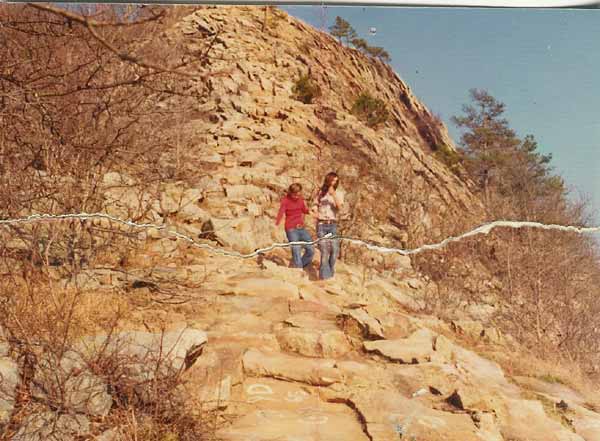 This is a photo of me at 15 hiking on a mountain west of Little Rock with a girlfriend, me with the long hair, she with the short, ha ha! She emphatically tore the photo in half and tossed it onto the ground when we split. I had a lot of girlfriends and switched often, because so many girls were interested in me, and I would engage in socializing with some of them, eventually angering a predecessor. We learn from experience that it's better to manage lovers' expectations of us, not too high...